
Cat window bed: what makes it a bed and not a ledge
Most listings sell the position and say nothing about the sleeping. That is the wrong way round: the position is what attracts a cat, but the surface is what keeps it there for the eleven or twelve hours a day it is actually asleep.
Why a cat sleeps at a window at all
Cats choose where to sleep on three criteria, and they apply them in the same order every time: height, because an elevated spot means seeing without being seen; warmth, because their comfort range sits above a heated room's; and field of view, because a cat that cannot see what is coming does not fully relax.
A window is the one place in an ordinary home that scores on all three at once. That is the whole reason a hard, narrow sill regularly beats an expensive padded basket left on the floor — and why moving the basket to the sill usually does not work either, since it is too deep to see out of.
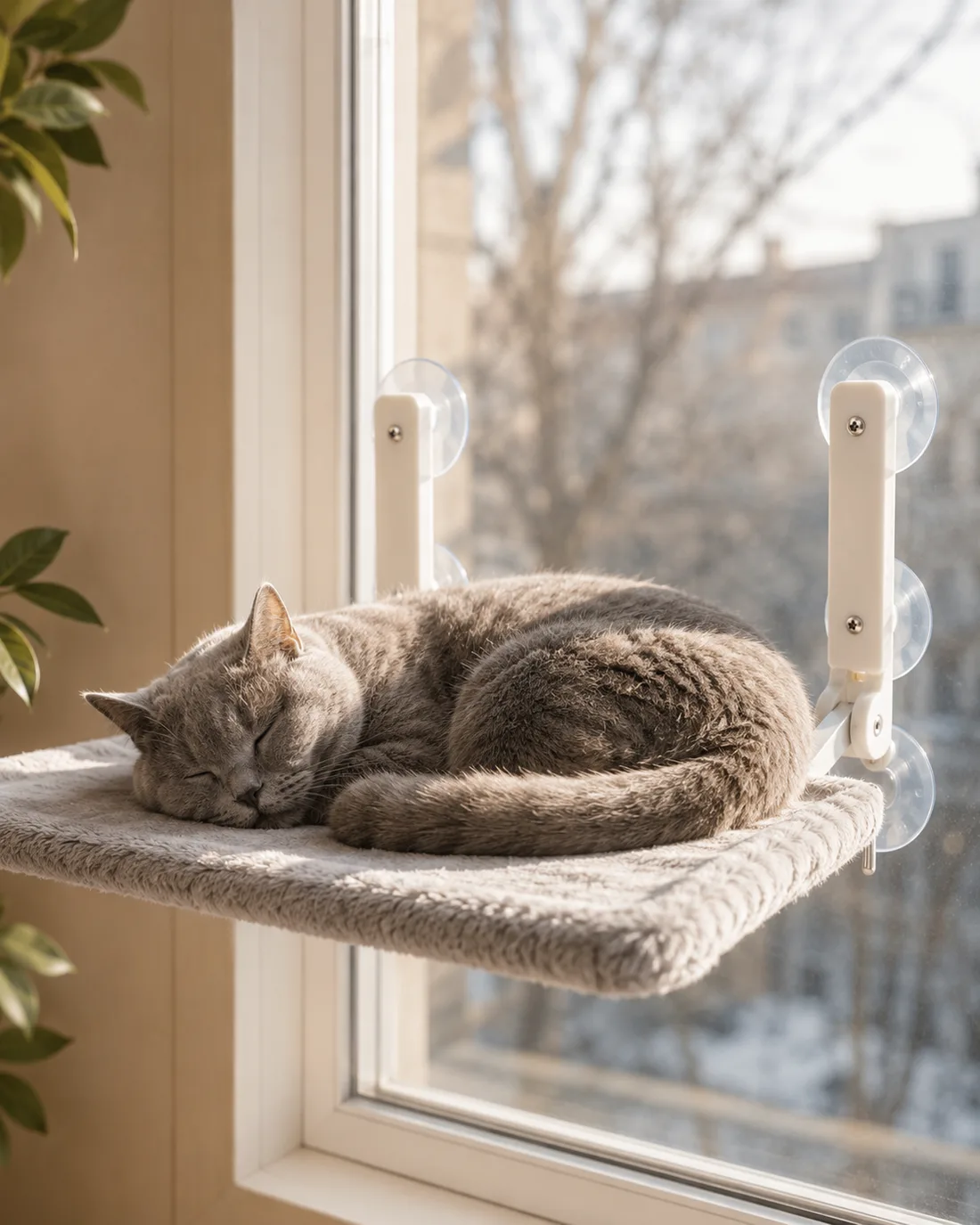
The dip is the whole point
A flat board holds a cat up. A slightly slack surface takes its shape, cups the flanks and gives the sense of being held — the same thing that explains a cat's devotion to cardboard boxes. It is not a marketing detail: the Feline Environmental Needs Guidelines published by the AAFP and the ISFM describe the ideal perch as elevated, padded, and having a hammock-style depression that provides a sense of concealment.
That is also why tension matters more than thickness. On the wooden model you tighten two thumb wheels until the canvas is taut but still gives under the palm. Overtighten and the cat lies on a board; leave it slack and the frame twists. There is a right amount, and you find it with your hand, not with a spec.
What changes with the season
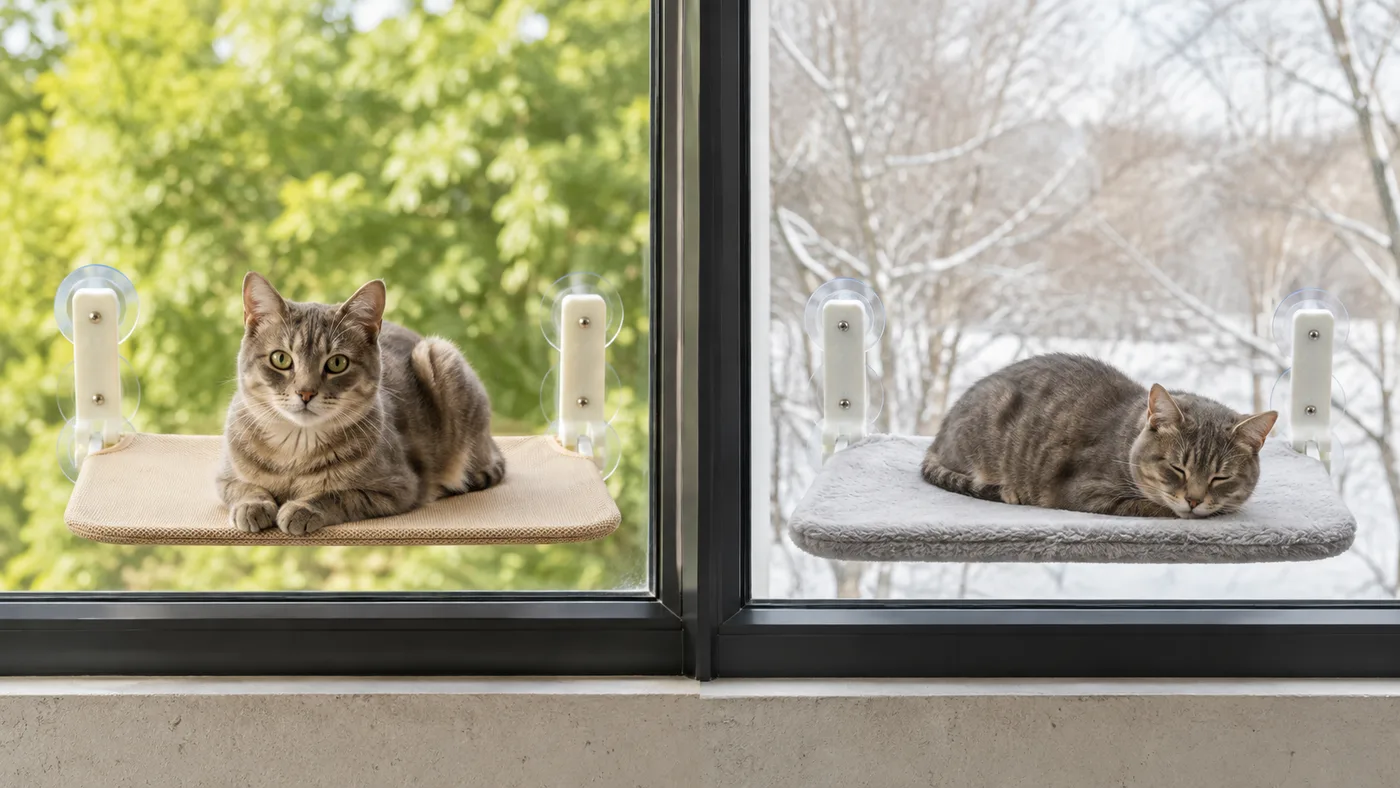
A bed at a window is exposed in a way a bed on the floor is not. In July, sun through glass turns a thick cushion into an oven; in January, the same spot sits against a cold pane. This is the one place where the choice of surface does real work rather than just looking different.
| Surface | Best for | Why |
|---|---|---|
| Beige mesh | Sunny and south-facing windows | Open weave, air passes through it, stays markedly cooler than a solid pad |
| Gray plush | Cold rooms, winter, north-facing glass | Holds heat against the cat instead of letting it go |
| Cotton canvas | All year, and where it needs washing often | Comes off the frame and goes in the machine at 30 °C |
| Radiator model | The heating season | Puts the bed in rising warm air rather than against the pane |
Some households simply keep two and swap them, which is less extravagant than it sounds: a mesh surface in summer and a plush one in winter cost less between them than one bed the cat abandons in August.
Height, and the step that gets the cat up there
A bed the cat cannot reach comfortably is not a bed. Very few cats will jump four feet onto a narrow surface they do not know, and an older or arthritic cat gives up on a height quietly, long before anyone notices it has stopped going up.
The fix is almost always an intermediate step rather than a lower bed: an armrest, a dresser, a radiator, a storage crate. Three surfaces at 16, 32 and 48 inches are worth more than one at 60, because a cat travels by route, not by leap. It also wants a way down that is not the way it came up — a dead-end shelf gets used for two days and then abandoned.
How much sleep you are actually accommodating
of sleep per 24 hours, measured by EEG in 18 cats
— Lucas and Sterman (1974), as reported by Campbell and Tobler, 1984
the part of the day when sleep peaks
— Sterman et al. (1965), as reported by Campbell and Tobler, 1984
Those figures are why the surface matters more than it looks. A cat is not choosing where to nap for twenty minutes; it is choosing where to spend more than half its life. The full picture is in our guide to how long cats sleep and where they choose to.
Which of the three works as a bed
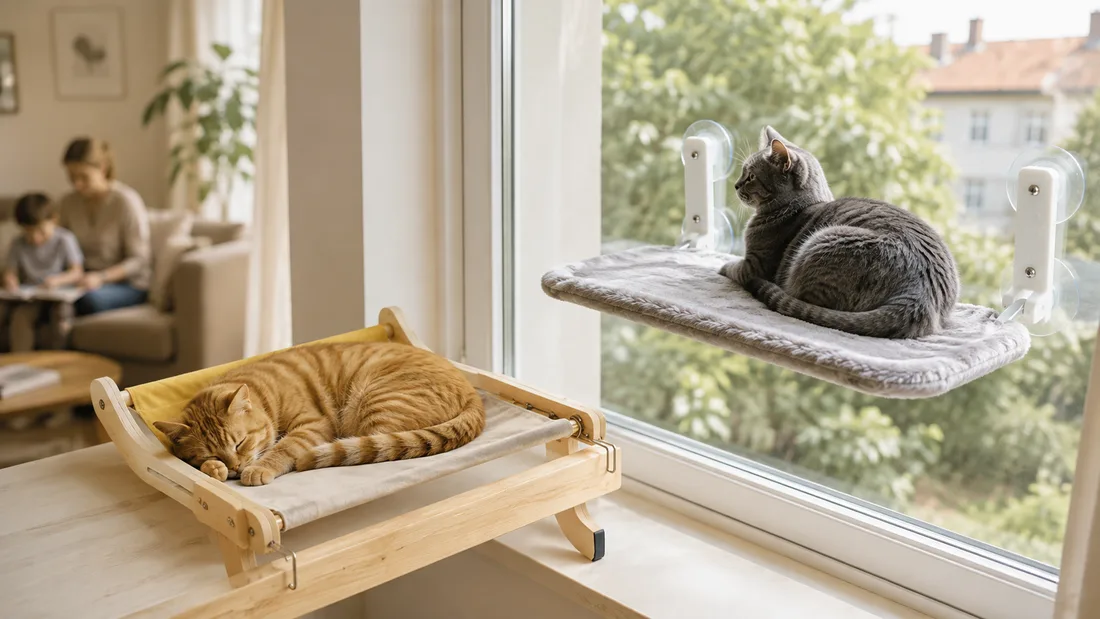
All three are slept in, but they answer different rooms.
The suction platform mounts on the glass itself and needs 19.9 in (50.5 cm) of smooth glass measured across the cups and arms — not the 45 × 30 cm the bed size suggests. It is the answer when the window has no usable sill, which covers most sliding doors and modern frames.
The wooden frame clamps onto a sill that projects, is flat and is reachable from underneath, with about 5 cm of clearance below the ledge for the clamp. Its canvas is the only surface here that machine washes, which matters with a cat that molts.
The radiator bed hooks over a radiator with a gap along the top and measures 46 × 30 × 25 cm. In the heating season it is the warmest bed in the house, and it has a backrest, which the other two do not.
Keeping it clean without wrecking it
A bed that is slept in daily gets dirty, and a bed that cannot be cleaned gets thrown away. The cotton canvas releases from its two tension bars, machine washes at 30 °C and may shrink very slightly on the first wash — harmless, the wheels take the tension back up. Air dry it rather than tumbling it.
The plush and mesh surfaces are cleaned in place with a brush and a damp cloth. On the suction model there is one extra habit worth keeping: wipe the cups and the glass every two or three months. A cup that starts creeping a few millimeters a day is not worn out, it is dirty, and a wipe restores the grip.
When a window bed is the wrong answer
Two situations, said plainly. A window that looks onto a blank wall or a closed courtyard gives a cat nothing to watch, and no bed rescues that — move it to a window with movement outside, even a smaller one. And a small number of cats simply never sleep up high, whatever you install. They are a minority, but they exist.
Everything else is usually placement rather than product: a thoroughfare, a door that slams, a height with no step to it. Our comparison of the three mounts works through which one suits which window.
Common questions about cat window beds
Will a cat really sleep in a window bed?
Yes, and usually more than in a bed on the floor. Recorded sleep in adult cats runs to around 13 hours in every 24, and cats pick their spots by height, warmth and field of view. A window delivers all three at once, which is why a narrow sill often beats a plush basket.
Mesh or plush for sleeping?
Plush holds heat and suits a cold room or a north-facing window. Mesh lets air through and stays markedly cooler behind glass in summer. If your window gets a lot of sun, mesh is the safer default.
Can the bed be washed?
The cotton canvas on the wooden model comes off and machine washes at 30 °C. On the suction and radiator models the surface is cleaned in place with a brush and a damp cloth.
Is a window bed warm enough in winter?
Behind glass in winter a bed can sit in a cold draught. The plush surfaces are the warmer choice, and the radiator model solves it outright by putting the bed in the rising warm air instead of against the pane.