
· Camille Ferrand
Cat-proofing a window: what actually works
A cat drawn to a window will get to it sooner or later. The question is therefore not how to keep it away, but how to make the approach safe.
The tilt-and-turn trap
A window tilted open at the top forms an inverted V. A cat trying to get through enters at the wide top, then slides: the more it struggles, the further it drops toward the narrow end. It wedges at the hips and cannot back out.
It is the case vets see come back every spring, as soon as people start airing rooms out. A cat has no way to anticipate the mechanism: the gap looks passable at the top, where it is wide.
There are guards made specifically for this, filling the V without stopping the airflow. If you fit only one thing, fit that one.
Netting or grille: what separates them
Netting stretches over a frame or fastens to the jambs. It is discreet, removable, and suits a rental. Choose a reinforced mesh: a cat that gets into the habit of climbing it will wear out a lightweight net quickly.
A rigid grille screws into the reveal. It is more work to fit but does not deform, which counts for a heavy cat or a balcony several floors up.
In both cases the fixing matters more than the material. Anything held in place by pressure alone gives way under repeated pushing, and a cat pushes every day.
High-rise syndrome
High-rise syndrome is the name given to falls from an upper floor. Contrary to the popular belief, a cat does not “always land on its feet”: it does right itself in the air, but that protects it from neither fractures nor chest injuries.
The aggravating factor is distraction, not clumsiness: a cat fixed on a bird or an insect loses all sense of the drop. That is why an appealing window needs securing even if your cat is normally careful.
Give it a safe post rather than a ban
Banning the window rarely works: the cat goes back the moment a door is open, and it goes back unobserved, which means unsupervised. The opposite approach does better: secure the opening, then put a comfortable bed behind the glass.
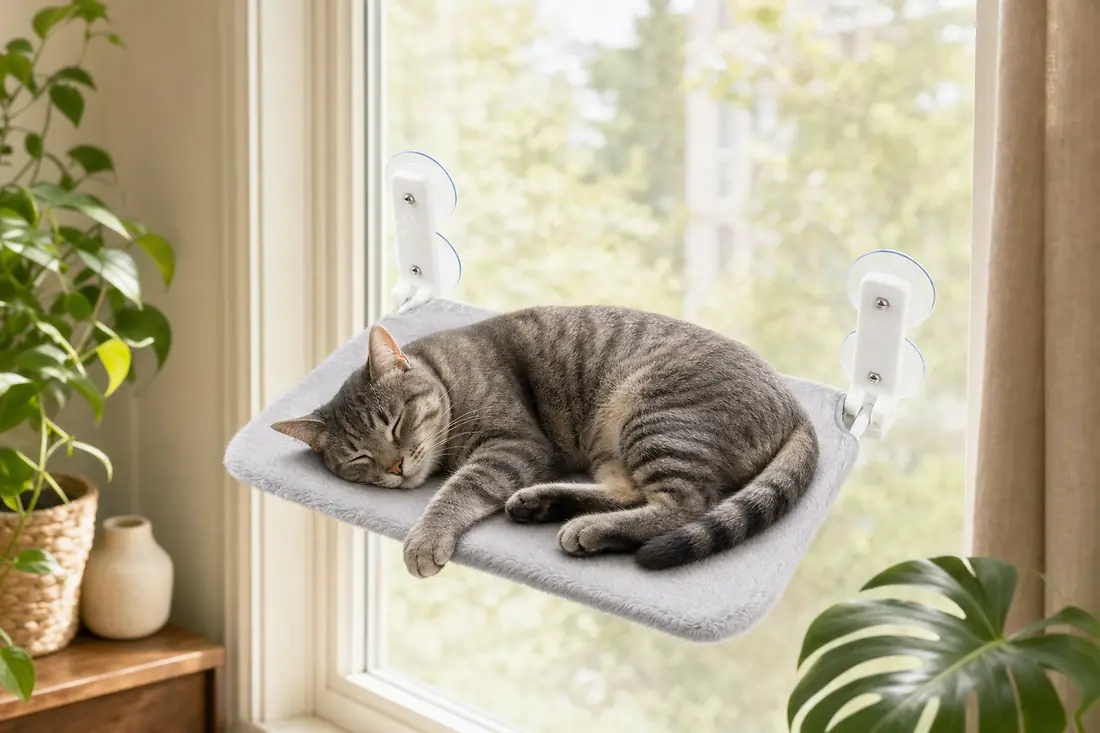
A cat with a stable post at the right height spends its time at the window rather than trying to get through it. That is exactly what a window hammock is for: it occupies the most contested spot in the room, on the right side of the glass.
Three checks before summer
Test it by hand. Press firmly in the middle of the net or grille: if the whole thing shifts in its frame, it will give way under a cat at speed.
Check the corners. A cat almost always gets through a slack corner, never the middle.
Look at what it can see. A window overlooking birds needs more serious protection than one facing a blank courtyard: how tempting it is makes the difference.

Camille Ferrand · Feline behaviorist — founder of Sunbask
Camille works with households living with one or more cats in flats. Her work turns on one question: where a cat chooses to settle, and why it ignores the bed you bought it. It was measuring dozens of window sills in clients' homes that led her to start Sunbask, and to the habit of publishing the measurements nobody else gives.
A balcony is a different problem from a window
The two are often treated together, wrongly. A window closes; a balcony does not. And a balcony railing is designed to hold back an adult, not a nine-pound animal that slips between the balusters or jumps over the top.
Three arrangements come up again and again: vertical balusters, whose typical 4 to 4½ in (10–11 cm) spacing lets most adult cats and every kitten through; a solid railing in glass or sheet metal, which nothing passes through but which the cat simply climbs; and the low parapet of older buildings, which does neither job.
In all three cases the answer is the same: netting stretched the full height, from floor to handrail, and running past the sides. Netting fitted only between the balusters leaves the route over the top open — which is precisely the one the cat takes.
Choosing netting: three criteria, not one
Not all netting is equal, and price is not the right guide.
The mesh. Below about 1¼ in (3 cm) a kitten cannot get its head through; above 2 in (5 cm) a slim adult can start through and get stuck, which is more dangerous than no netting at all. A 1¼ in mesh is the standard compromise.
The material. Reinforced polyethylene survives UV for several seasons; plain nylon turns brittle in a single south-facing summer. Netting that has whitened has lost its strength, even where it looks intact.
The fixings. This is what fails, never the netting itself. Plastic cable ties last a season; tensioned cable and screwed fittings last years. In a rental, clamp systems that grip the railing avoid drilling and come off without a mark when you leave.
One simple test once it is up: lean your weight on the netting, halfway up. If it gives but the fixings stay put, it is sound. If a fixing moves, it will move under a cat at speed too.
Summer: airflow against safety
This is the real July trade-off, and it is not a minor one: the great majority of accidents happen when a window is opened to air a room. Three options exist, from the most demanding to the least.
A screen on its own secures nothing: it is built to stop an insect, and a cat that puts its weight on it pops it out of its frame. A great many falls happen exactly this way, with the owner believing the window was protected.
A security grille screwed into the window reveal is the safest answer, and the most permanent — so rarely an option in a rental.
Tilting the window with a restrictor lets you air the room without creating a passable opening — provided the restrictor genuinely limits the angle and the side triangle is blocked off. It is that triangle, not the gap at the top, that traps cats.
One closing remark, which is an observation rather than a tip: a cat with a comfortable lookout at the glass spends far less time hunting for a way outside. Passive safety and how you arrange the room are not two separate subjects.
A word on cats that have never been a problem
A lot of owners write the same thing: “mine goes to the edge, looks, and never jumps.” That is accurate, and it holds right up until the day something moves outside — a bird, another cat, a noise — and triggers a chase reflex that bypasses any judgment of height.
Falls almost never involve careless cats. They involve startled ones. That is why years of observed caution are not a guarantee, and why you judge your safety measures on what can happen once, not on what usually happens.
What the reference study on falls says
of falls happen between April 1 and September 30 — 77 cases out of 119
of the cats that fell were under a year old
— Vnuk et coll., Journal of Feline Medicine and Surgery, 2004
survived the fall — but 46.2% with a limb fracture
— Vnuk et coll., Journal of Feline Medicine and Surgery, 2004