
· Camille Ferrand
How long do cats sleep, and where do they choose to?
The duration is well known. What is less known is the logic behind the choice of place — and why the expensive bed you bought stays empty.
A cat's day, hour by hour
A cat is not nocturnal but crepuscular: its activity peaks at dawn and at dusk. In between it sleeps in stretches of twenty minutes to two hours, broken up by spells of light waking during which it stays alert to what is around it.
That pattern explains a behavior that often baffles people: a cat that “sleeps all day” and then demands attention at six in the morning is not out of step with anything, it is following its own rhythm.
The three criteria for a good spot
Height. An elevated point gives a clear view and puts distance between the cat and the traffic. It is the dominant criterion, and the one that explains the top of the wardrobe.
Warmth. A resting cat consistently seeks out the warmest point available: sun, an electrical appliance, a radiator.
Field of view. A cat sleeps better where it can see what is coming. An enclosed bed tucked into a corner with no sightline gets ignored, however comfortable it is.
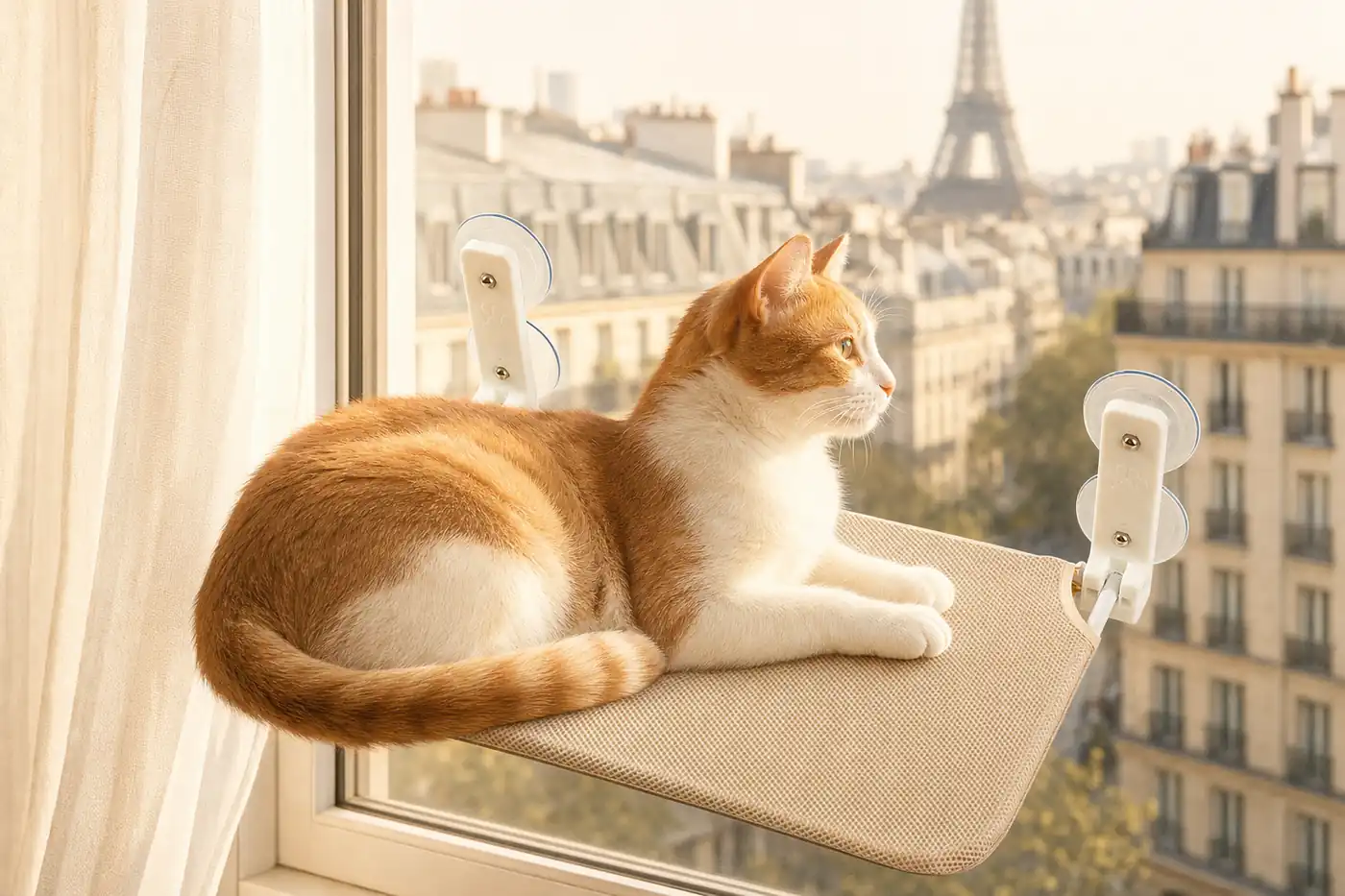
A window delivers all three at once: it is up high, it warms in the sun, and it looks onto whatever moves. That is why a narrow, hard sill regularly beats a plush bed on the floor.
Why the cat bed stays empty
The classic basket fails all three at once: it is on the floor, away from any heat source, and often walled in such a way that it limits the view. Comfort underfoot only comes fourth in the preferences we observe.
It is also why a cat moves several times a day: it follows the sun. A single post, however perfect, does not cover a whole day — hence the case for two, facing different ways.
When the duration becomes a signal
Individual variation around those 13 hours is wide, and a cat that sleeps a lot is not necessarily a cause for concern. What counts is change: a cat that slept 12 hours and abruptly moves to 20, or that abandons its usual posts to hide somewhere dark, warrants a visit to the vet.
Giving up a lookout is in fact a good indicator: a cat that deserts the window for the back of a closet is almost always telling you something.
Arrange it for the cat's rhythm, not ours
Two or three elevated posts, facing different ways, beat one premium bed in the wrong place. One on the morning side, one on the afternoon side: the cat follows the light, and you get the back of the couch returned to you.

Camille Ferrand · Feline behaviorist — founder of Sunbask
Camille works with households living with one or more cats in flats. Her work turns on one question: where a cat chooses to settle, and why it ignores the bed you bought it. It was measuring dozens of window sills in clients' homes that led her to start Sunbask, and to the habit of publishing the measurements nobody else gives.
Light sleep, deep sleep
Not all of a cat's sleep is the same. Most of those hours are light sleep: the ears move, it reacts to the smallest noise, and it can be on its feet in a second. Only a fraction of the day is deep sleep, the kind in which you sometimes see it twitch or paddle its paws.
That split explains a detail which fools a lot of owners: a cat “asleep” on its window post is in fact lightly awake most of the time. It is on watch. It is also why the view weighs so heavily on the choice of place — a post with nothing to observe is of no interest, even for sleeping.
What changes with age
A kitten sleeps up to twenty hours a day, which its growth requires. An older cat comes back to comparable figures, but for a different reason: tiredness and arthritis shorten its active spells.
The arrangement has to follow. In an older cat, a post that has become unreachable is not abandoned out of indifference but because the jump has got hard. Adding an intermediate step — a stool, a dresser — is often enough to give it its favorite spot back.
The part played by light
A cat follows the sun through the house, post after post, across the day. It is the strongest argument for two beds rather than one: one that catches the morning, one that catches the afternoon. You will see the move happen at almost the same time each day.
Why it moves several times a day
A cat that relocates four times in a day is not indecisive: it is tracking two moving variables, temperature and light.
In the morning it wants warmth — a radiator, an east-facing patch of sun, a bed still holding body heat. By midday the room has warmed up: it comes down, looks for a cool surface, often high up but in shade. Late afternoon the sun swings west and it climbs again. In the evening it returns to the heat sources.
That circuit explains why a single bed, however good, is never quite enough: it cannot be warm at eight in the morning and cool at three in the afternoon. Two or three posts of different kinds — one warm, one ventilated, one high — cover the day better than one perfect post does.
The circuit is also a useful indicator: a cat that abruptly stops circulating and stays in one place all day has changed a habit, and a lasting change of habit justifies a trip to the vet.
Too much, or too little: where the line sits
Those 13 hours are an average, and the normal extremes are wide: a kitten or an older cat can sleep 20 hours without it meaning anything at all, while a well-stimulated young adult sometimes drops to 11.
So it is not the duration that tells you anything, it is the change. A cat that slept 13 hours and has slept 19 for the past fortnight has changed something; a cat that has always slept 19 hours has changed nothing at all.
The other signals that matter are the ones that come with the sleep: a cat that is hard to wake, that hides in unusual places, that stops grooming, or that consistently picks the cold floor when it used to want warmth. Those are matters for a vet, not for furniture — but they are far easier to spot when you know your cat's habits.
Does a cat sleep better alone or near us?
Both, at different times. Deep sleep, which takes up roughly a quarter of its resting time, needs somewhere the cat feels out of reach: high up, backed against something, away from the traffic. Dozing, on the other hand, it will happily do three feet from us, on an armrest or a ledge.
A cat with nothing but floor-level beds in the living areas gets plenty of dozing and little deep sleep. Adding an elevated post does not replace the bed in the living room: it adds the second category, the one that was missing.
What the measurements say, rather than the range
of sleep per 24 hours, measured by EEG in 18 cats
— Lucas and Sterman (1974), as reported by Campbell and Tobler, 1984
of the time spent asleep — 13.3 h out of 23 h recorded, in 8 cats
— Sterman et al. (1965), as reported by Campbell and Tobler, 1984
the part of the day when sleep peaks
— Sterman et al. (1965), as reported by Campbell and Tobler, 1984