
Cat furniture hammock: the clamp does not know it is on a window
People arrive at this from two directions. Either the window turned out to be impossible, or the room simply has a better edge than the window does. Both end up in the same place.
What the clamp actually needs
Three conditions, and they are the only ones.
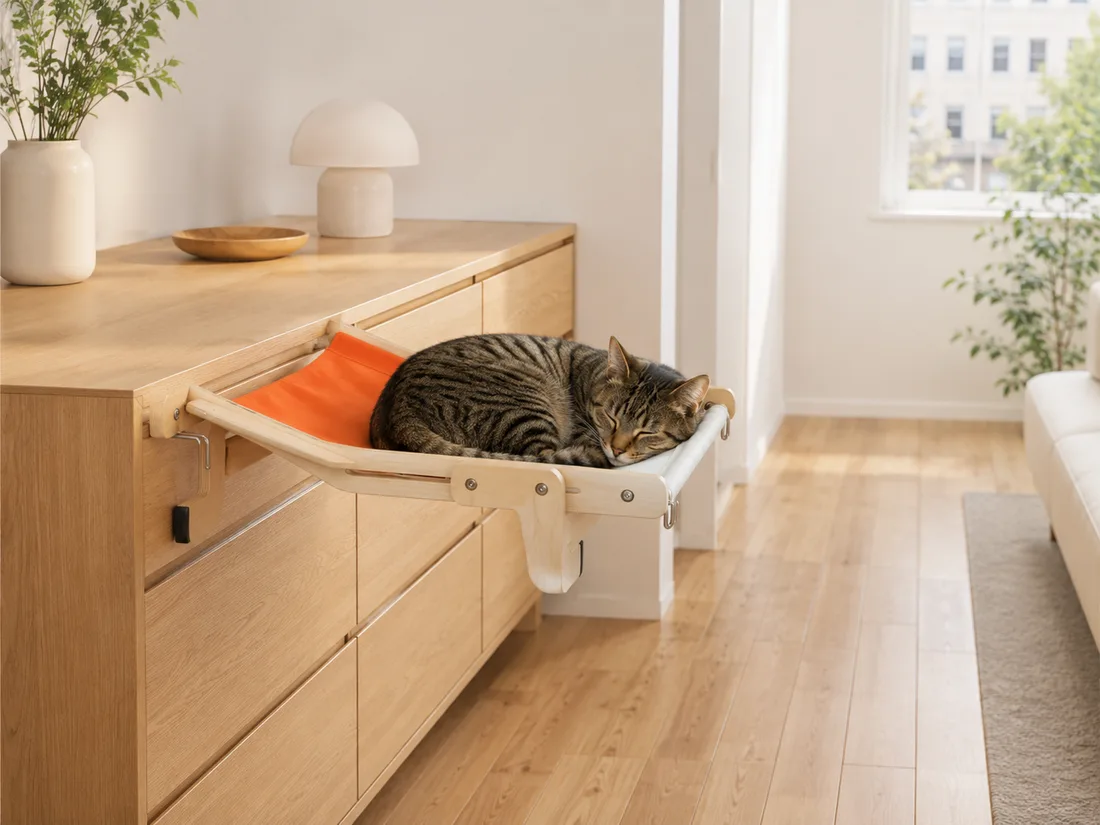
The edge projects. The frame grips over the top and hooks underneath, so there has to be an underneath. An edge flush to a wall gives the clamp nothing to close on.
The edge is flat. A rounded moulding or a heavily profiled lip reduces the contact area. Flat is not a formality here, it is what stops the frame rocking.
There is about 5 cm of clearance below. This is the figure people miss. A drawer runner, a radiator, a support bracket or a skirting immediately under the edge takes the space the clamp needs — and it is the one thing no adjustment rescues.
What works, in practice
| Surface | Works? | Watch for |
|---|---|---|
| Chest of drawers | Yes | Drawer runner under the top edge |
| Desk or table top | Yes | An apron rail beneath the top |
| Kitchen worktop | Yes | Appliances or cupboards immediately under |
| Bookcase side or top | Yes | Thin panels flex more than solid timber |
| Edge flush to a wall | No | No underside to clamp to |
| Rounded or moulded lip | Partly | Reduced contact; check for rocking |
The frame itself measures 38 × 43 × 21 cm, so allow that much of the edge for it to sit square rather than overhang.
Why a furniture edge is often the better spot
Cats choose where to settle on height, warmth and field of view. A window scores on all three, which is why it is the usual answer — but a dresser beside the window scores nearly as well and solves two things the window cannot.
It gives the cat a route. A hammock at 32 inches on a dresser turns an unreachable sill into a two-stage climb, and a cat travels by route rather than by leap. Three surfaces at 16, 32 and 48 inches are worth more than a single one at 60.
And it moves. Following the sun through a flat is a real behavior — a cat relocates several times a day, tracking temperature and light — and a mount that unclips in two minutes lets the bed follow instead of staying where it was convenient to install.
It also stands on the floor, and that is not a fallback
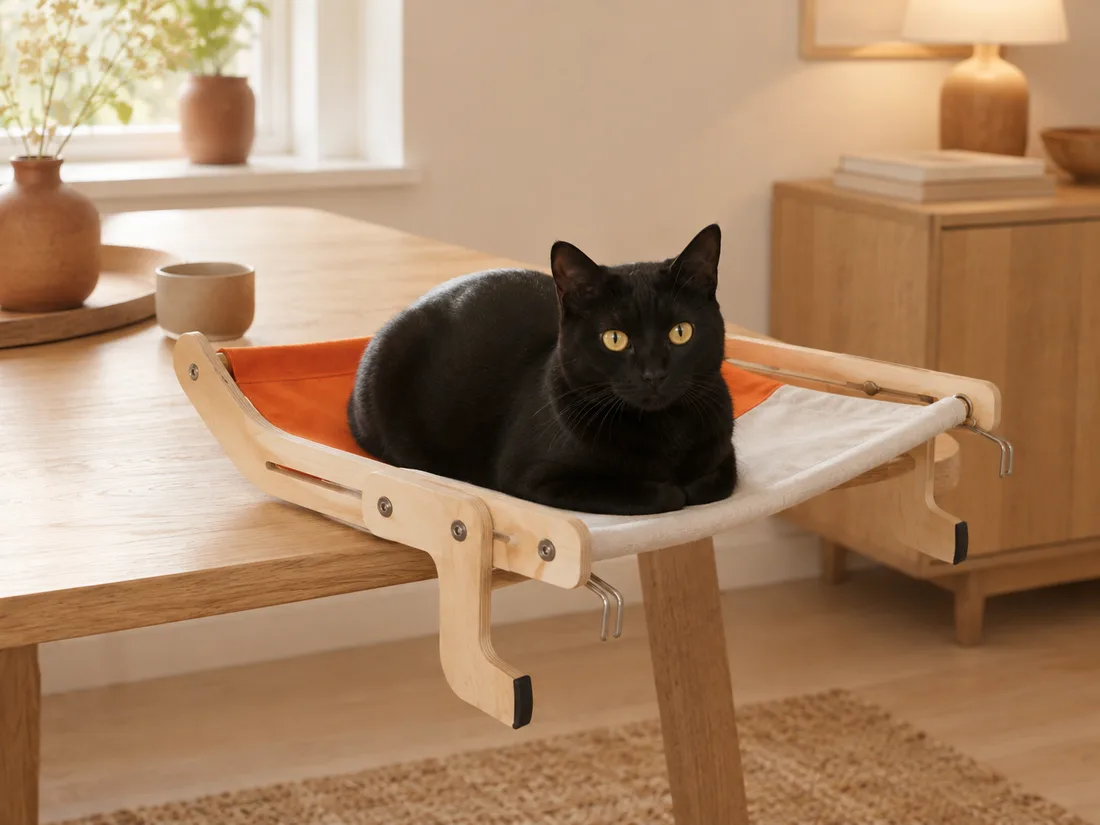
Taken off its edge, the frame stands on its own. That turns it from a perch into a floor bed, which matters in two situations: when every good edge is already taken, and when an older or arthritic cat has quietly stopped climbing. An elevated bed a cat can no longer reach is not a bed at all, and lowering it is a better answer than replacing it.
Not marking the furniture
The clamps have soft tips and hold by pressure rather than by biting in. On varnished plywood, laminate or a sealed worktop they leave nothing. On a soft finish, a wax or an oiled timber, treat them as you would any clamp: check underneath after the first few days rather than after a month.
The tension of the canvas is the other thing to get right, and it is done by hand. Tighten the two thumb wheels until the fabric is taut but still gives a little under the palm. Overtighten it and the cat lies on a board; leave it slack and the frame twists on its clamps.
Washing it
The cotton canvas releases from its two tension bars, machine washes at 30 °C and air dries. It may shrink very slightly on the first wash, which is harmless — the wheels take the tension back up. The varnished plywood wants a damp cloth and no standing water.
This is the only one of the three surfaces we sell that goes in a machine, which is worth weighing if the cat molts heavily or the hammock will live in a kitchen.
What the cat will be looking at
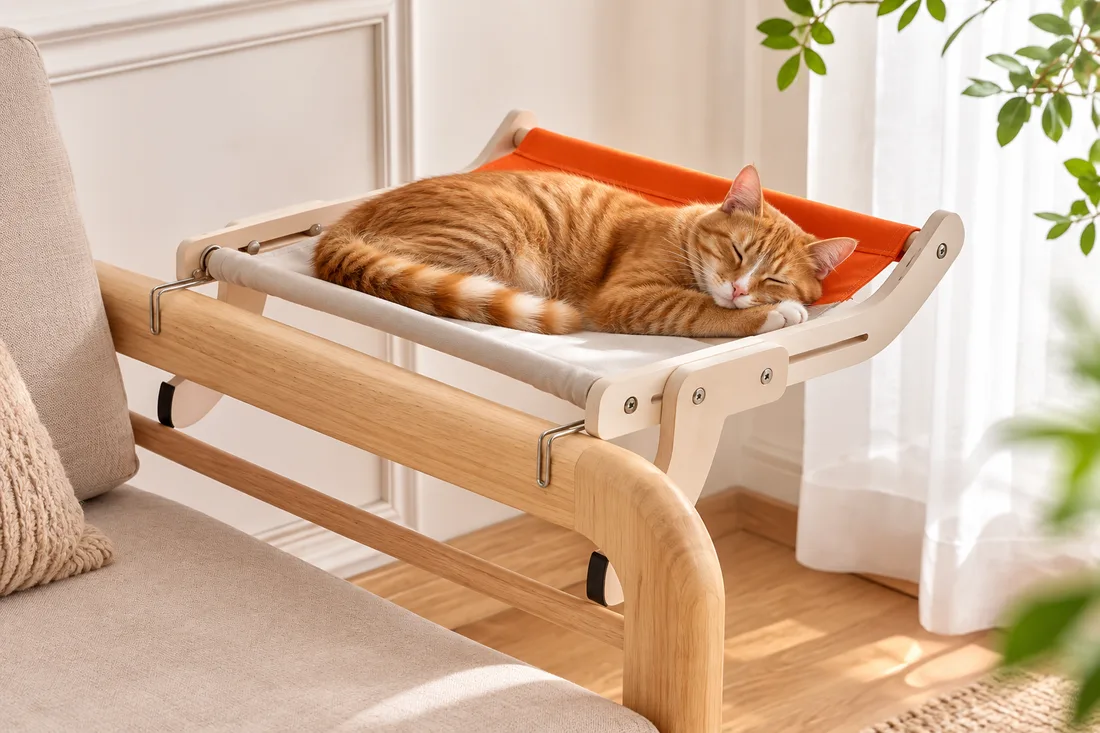
What a cat can see decides how long it stays: a street or a bird feeder holds it for hours. An edge facing into the room gives it the height and the warmth but nothing to watch, so pick the edge nearest a window where you have the choice. Where the sill itself will not take a clamp, the platform mounts on the glass and needs 19.9 in (50.5 cm) of smooth pane.
Our comparison of the three mounts covers which one fits which room, and vertical space in a small home covers how to build the route between them.
Common questions about furniture hammocks
What kind of furniture edge does it clamp to?
Any edge that projects, is flat and is reachable from underneath, with roughly 5 cm of clearance below it for the clamp. A chest of drawers, a desk, a worktop and a bookcase side all qualify. What does not is an edge flush against a wall.
Will it mark the furniture?
The clamps have soft tips and grip rather than bite. On a varnished or laminated surface they leave nothing; on a soft or waxed finish, as with any clamp, it is worth checking after the first few days.
Can it be moved between a window and a dresser?
That is the point of the mount. It comes off in a couple of minutes and goes back on somewhere else, which is what makes it work for people following the sun through the day or moving house.
Does it stand on the floor as well?
Yes. Unclamped, the frame stands on its own on the floor, which makes it a bed rather than a perch — useful when the window is taken or when an older cat has stopped climbing.